 A field guide to getting there without the gas.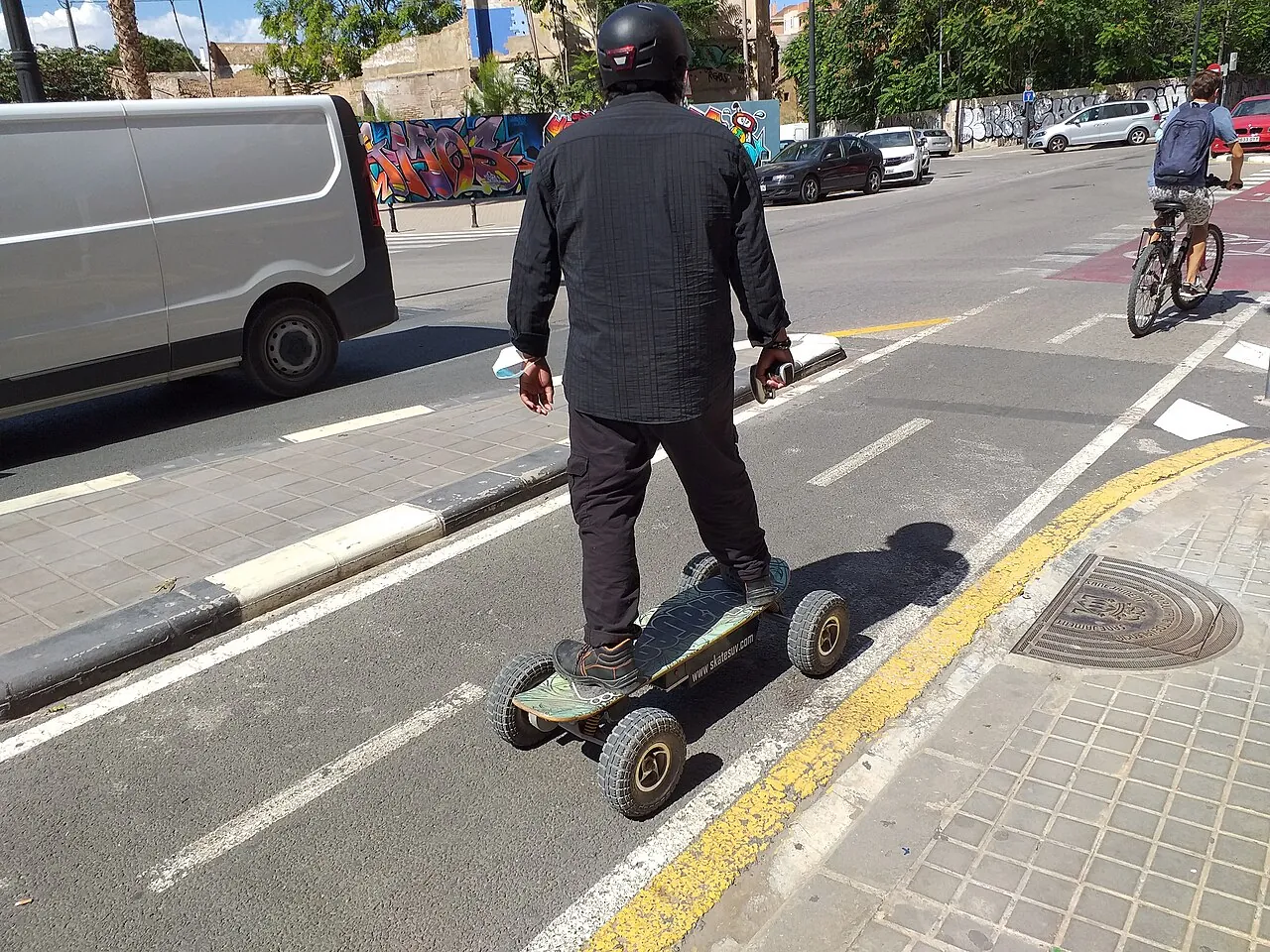
Start with the pavement
Walk the route and look down. Expansion joints, patched trenches, stones, drain grates, rails and driveway lips can all change how a small wheel behaves. Notice the hills and where you'd have trouble stopping suddenly. Urethane street wheels feel quick and direct on clean pavement. Bigger rubber or air-filled wheels soften rougher ground, at the cost of weight, rolling resistance and more maintenance. Choose with the worst part of the trip in mind, not just the smooth stretch outside the shop.
The compact Exway Wave V2 runs 85 x 56 mm solid polyurethane wheels. Tynee’s Ultra Belt uses 105 mm solid urethane in the catalog configuration. The Backfire Ranger X6 moves to 165 mm honeycomb airless rubber. The Tynee Explorer version shown here uses 175 mm pneumatic wheels with inner tubes. Bigger wheels smooth more of the route, and they usually come on a heavier board.
The remote controls the board
On an electric skateboard, your hand controls both acceleration and regenerative electronic braking through the remote. None of these four boards has a separate hand-operated mechanical brake. Check the connection, trigger, mode and battery before leaving. Start with low power and gentle braking settings, and practice smooth stops on flat, open pavement. Learn how far the trigger moves and what that movement does before riding around other people.
Braking can feel different with speed, slope and battery charge. Read the maker's instructions for descending near full charge, and avoid a commute that needs maximum braking all the way down a long hill. Belt drives need belt-tension checks and spare belts. Hub drives avoid that job but still need their motor sleeves, bearings and wheels checked. Put the remote where nothing can press its trigger and check that it's paired with the right board. Try a borrowed remote before leaving home. Wet leaves and uneven pavement make a sudden braking mistake much harder to recover from than on a bicycle with a familiar brake lever.
Where smaller boards make sense
The Wave V2 weighs a listed 15.21 lb and uses a 99 Wh quick-release battery. Its compact deck and 9.3-mile advertised range make it worth considering for a short, smooth trip with frequent carrying. Tynee's Ultra Belt is 18.9 lb with a larger 374.4 Wh pack and an up-to-24-mile claim. Both weigh less than most scooters, which helps when you have to carry them.
Range and rough-road capability add mass quickly. The Ranger X6 weighs 28.22 lb and lists 18 to 21 miles under a published 180 lb rider, 18.5 mph flat-road scenario. The selected Explorer is 30 lb and claims up to 36 miles on its pneumatic all-terrain wheels, using a 143 lb rider in the lowest speed mode under ideal conditions. Its separate 52-mile figure requires a street-wheel conversion. Weight is only part of it: a long 30 lb deck can be awkward in a coffee line even if you're comfortable lifting it.
Which board suits the street?
Scroll sideways to read all columns.
| Model | Relative price | Wheel setup | Best route fit |
|---|---|---|---|
| Exway Wave V2 | Midrange | 85 mm solid polyurethane | Very short, smooth trips with frequent carrying. |
| Tynee Ultra Belt | Budget | 105 mm solid urethane | Value-focused paved commuting with belt maintenance. |
| Backfire Ranger X6 | Midrange | 165 mm honeycomb airless rubber | Broken pavement without pneumatic flat maintenance. |
| Tynee Explorer | Midrange | 175 mm pneumatic, tubed | Rougher surfaces where comfort outweighs 30 lb carry weight. |
Try turning the board as well as riding straight. Double-kingpin trucks can carve deeply and feel lively at low speed; they may feel less settled as you go faster until you've adjusted them and learned the response. Deck flex changes with rider weight and stance, so a deck that softens vibration for one rider may feel wrong under another. Your route and the way you like to stand tell you more about the right board than a top-speed video.
Certification, charging and flying
We haven't found an exact whole-board or battery certification record on the pages for the Wave V2, Tynee Ultra Belt, Ranger X6 or this Explorer version. Ask the seller which standard covers the board, who certified it and where you can check the record. Get a photo of the exact product label and keep the answer with your receipt. A named cell brand, enclosure rating or certified charger doesn't certify the complete board.
The Wave V2's removable 99 Wh battery sits below the FAA's general 100 Wh limit for many personal-device lithium batteries. That alone won't get the board onto a flight. Airlines can be stricter, and some ban electric skateboards regardless of battery size. Check your carrier before every trip and get any required approval before heading to the airport; a 'flight safe' product description isn't enough. At home, use the charger specified for that battery, stay present while it charges and keep exits clear. Stop using a battery that's damaged, swollen, unusually hot or behaving differently.
Would you still take it on a workday?
A regularly wet route, leaf litter, rails or rough seams can make a skateboard a poor daily choice. Consider another ride if you need mechanical brakes, a seat or room for substantial cargo. Give yourself time to learn before riding in traffic. Even an experienced push skater needs to get used to powered acceleration, remote braking and a different truck setup. Check local device definitions too: the board may be allowed in fewer places than a bicycle, which can change the route entirely.
Solid urethane and honeycomb wheels don't take liquid sealant. Check them for chunks missing from the surface, cracks and worn sleeves. On the Explorer's 175 mm wheels shown here, the air is held in inner tubes; Tynee specifies roughly 32 to 34 psi. We'd choose Armor-Dilloz Red for air-filled tires at 30 mph or less. Check the shipped wheels and tubes against the sealant instructions and find out what's already inside before adding it. Small tread punctures are what it's for. A cut casing or damaged tube valve needs a repair. Carry the supplied pump and spare tubes when taking the bigger board on a route where a walk home would be difficult.