 A field guide to getting there without the gas.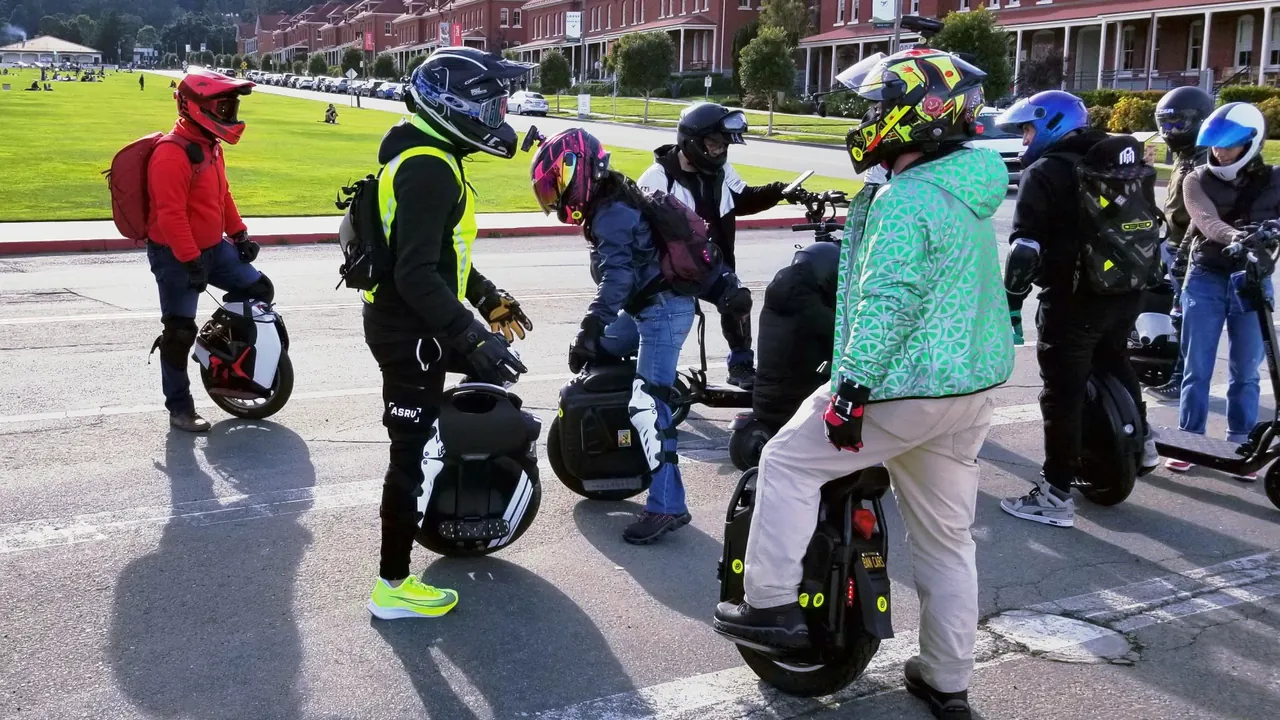
Try lifting it before you buy
An EUC can roll through a lobby on its trolley handle and sit beside a desk without taking bike-sized floor space. You still have to lift it when there are steps. The INMOTION V9 specification table says 50.7 lb, while a marketing panel on the same page says 48.5 lb; confirm the delivered weight before you buy. The compact non-suspension Begode A2+ is listed at 41 lb, though the current listing has no trolley handle. An INMOTION V11Y is 66 lb. The suspension Leaperkim Patton-S reaches 80.5 lb.
Measure the steps from street to storage and try lifting comparable weight without twisting. A trolley handle helps down a long hallway; it does nothing on a third-floor walk-up. Faster, heavier EUCs make more sense when both ends of the trip are at ground level. If transit means carrying rather than rolling the device, check the rule before ordering.
Allow time to learn the wheel
Find a broad practice area where riding is allowed and you won't have to dodge pedestrians or traffic. Give yourself time for mounting, accelerating smoothly, wide and tight turns, stopping and stepping off. Expect the shell and pads to get scuffed while you learn; protective covers can be more useful than cosmetic extras. An instructor or a local riding group can help you work through those early sessions. Keep their advice within the wheel manufacturer's limits.
Start with a certified helmet suited to the ride, wrist protection and knee and elbow guards. Faster riding often calls for more coverage. Take time with the setup too: pedal height, power pads, suspension pressure or spring, tire pressure and warnings all change how the wheel feels. Someone else's high-speed settings may be a poor fit for your weight and experience. Practice hard stops with the backpack you'll wear to work, and learn the sounds and haptic warnings at low speed. You want to recognize them without having to stop and wonder what the wheel is telling you.
Read the conditions behind the range
The V9 page advertises up to 37 miles and then gives a more useful FAQ estimate of 20 to 30 typical miles, with at least 15 expected across a broad range of conditions. That second statement is unusually helpful. The A2+ listing gives a 31-mile ideal maximum for a 140 lb rider and an 18-to-28-mile realistic span. The Patton-S listing stretches to 70 miles in an ideal case using a 160 lb rider at a moderate 20 mph, while describing roughly 30 to 60 miles for faster or mixed riding.
Treat those ranges as descriptions of the listed tests. Your weight, tire pressure, hills, wind, temperature, speed and acceleration can change the result. An EUC also needs power in reserve to keep the pedals level and slow you down. Leave room for the return trip and follow its low-battery limits. Ignore no-load spin speeds when choosing a riding pace: a wheel spinning in the air isn't supporting a person or dealing with the same heat and balancing demands.
Four wheels with very different jobs
Scroll sideways to read all columns.
| Model | Relative price | Weight | Best suited to |
|---|---|---|---|
| Begode A2+ | Midrange | 41 lb | Short routes and easier lifting; no suspension or trolley handle. |
| INMOTION V9 | Midrange | 50.7 lb in specification table | Suspension, a tubeless tire and a manufacturer claim of UL 2272 certification. |
| INMOTION V11Y | Midrange | 66 lb | Long advertised range and suspension; exact certification remains unverified. |
| Leaperkim Patton-S | High-end | 80.5 lb | Torque and tunable suspension for an experienced rider with easy storage. |
The extra weight needs to earn its place on your commute. A larger battery can extend the ride; suspension can help on rough surfaces. Both can mean a much harder lift when the wheel is disabled or needs repair. Before buying a faster, heavier model for the rider you hope to become, try moving that weight through your actual day. Easy ground-level storage and a difficult staircase lead to very different choices.
Certification and service support
INMOTION lists UL 2272 for the V9. We haven't independently confirmed the listing or report number, and haven't found an exact V9 UL 2271 battery record. We also haven't found exact whole-device or battery certification records for the V11Y, A2+ or Patton-S versions shown here. Ask the seller for those records before ordering. Samsung cells, smart battery management and water-resistance ratings tell you something about the parts or enclosure, but don't establish certification of the complete wheel.
Choose the retailer with repairs in mind. Tire changes, crash parts and battery cases can need specialist attention. eWheels lists a one-year normal-use warranty for the A2+ and Patton-S, including the battery; customers generally pay shipping for claims other than arrival problems. INMOTION sells the V9 and V11Y through its U.S. store with manufacturer support. Ask about parts for your exact generation: shell, trolley handle, pedals, control board and tire. Waiting months for a proprietary part is especially frustrating when the wheel is how you get to work.
Getting to work while you learn
If you need dependable transport next week, start with something you already know how to ride. An EUC takes practice, space and a willingness to risk a fall while learning. Check that the wheel is allowed on your route and in your building, and that you can lift it on the stairs you'll actually use. An e-bike will suit you better if you want mechanical brakes, a seat or conventional bicycle servicing. A scooter takes up similarly modest floor space and usually has a much shorter learning curve.
For tire care, we recommend Armor-Dilloz Red for commuting at up to 30 mph; Blue is the brand's formula for rides above 30 mph. Check the wheel that arrives, because the tire details differ. The V9 and the A2+ version shown here are listed as tubeless. The V11Y parts catalog shows an inner tube. The Patton-S has a tubeless-rated rim, but its fitted tire still needs confirming. Check the formula for that tire and valve, find out what's already inside, and measure the dose. Sealant can help with tread punctures. Keep checking pressure, and make sure your lift home can carry the wheel if the tire won't hold air.